Damp patches, bubbling paint, a musty smell or a warm spot on the wall can all point to a hidden leak. Here is how to read the signs, do the safe checks yourself, and why the professional route avoids cutting into your wall speculatively.
A leak behind a wall is one of the most frustrating problems a homeowner can face. You can see the damage taking hold, a patch of damp spreading, paint lifting, a skirting board darkening, yet the source is hidden from view. The instinct is to grab a bolster chisel and start opening up the wall to chase it. In almost every case that is the worst thing you can do. This guide explains how to recognise the signs of a concealed leak, what pipework actually runs inside your walls, the safe checks you can carry out yourself, and how a professional leak detection company in London finds the source without turning your home into a building site.
Why leaks behind walls are so hard to pin down
Water does not behave logically once it escapes a pipe. It follows the path of least resistance, running along joists, tracking down the back of plasterboard, wicking through masonry and pooling wherever gravity takes it. That means the wet patch you can see is frequently not above or beside the actual leak, it can be a metre or more away, sometimes on a different wall or even a different floor. This is exactly why speculative cutting fails so often. You open the wall where the damp shows, find dry pipework, and now you have a hole to repair as well as a leak you still have not found.
The other complication is that not every damp wall is a plumbing leak at all. Penetrating damp from a failed external wall, rising damp, condensation and a genuine pipe leak can all look remarkably similar on the surface. Telling them apart is the first job, and getting it wrong is expensive. Our guide on whether a water stain on a wall is a leak or damp goes into that distinction in detail, and it is worth reading before you assume the worst.
The signs of a hidden leak behind a wall
Concealed leaks rarely announce themselves. They build slowly, and the earliest signs are easy to dismiss. Learning to read them early can save you thousands in secondary damage. Here are the indicators worth taking seriously.
Damp patches and staining
The classic sign is a discoloured patch on the wall, often yellow, brown or tea coloured at the edges. A leak stain typically has a defined tide mark and may feel cool and damp to the touch. Unlike condensation, which tends to affect broad areas evenly, a leak stain is usually localised and grows over days or weeks. If the patch reappears quickly after you have dried and repainted it, that is a strong hint the moisture is being fed from behind.
Bubbling, blistering or peeling paint
When moisture sits behind a painted or wallpapered surface, it breaks the bond between the finish and the plaster. You see bubbling, blistering, or paint that lifts away in sheets. Wallpaper seams open up and the paper feels soft. This is one of the more reliable signs of sustained moisture rather than a one off spill.
A musty or earthy smell
Trapped moisture feeds mould and mildew inside the wall cavity long before you see any growth on the surface. A persistent musty, earthy smell in a room, particularly one that does not shift with ventilation, often means water is sitting somewhere it should not be. Your nose can detect a hidden leak weeks before your eyes do.
A warm patch on a wall carrying hot pipes
If the leak is on a hot water or central heating pipe, the escaping water warms the surrounding plaster. Running the flat of your hand across the wall can reveal a patch that is noticeably warmer than the area around it. This is a genuinely useful diagnostic clue because it points to heating or hot supply pipework rather than a cold feed or waste.
The sound of trickling or running water
In a quiet house, especially at night, you can sometimes hear a faint trickle, hiss or drip inside a wall when no taps are running and no appliances are in use. On a pressurised supply pipe the sound can be a continuous fine hiss rather than a drip. If you can hear water moving when everything is turned off, you almost certainly have a leak somewhere on the pressurised side.
Other supporting signs
- An unexplained rise in your water bill, or the water meter ticking over when everything is off.
- A drop in water pressure at taps or the shower.
- The boiler pressure gauge falling and needing regular topping up, which points to a leak on the sealed heating system.
- Efflorescence, a white powdery salt deposit, appearing on brick or plaster as water evaporates through masonry.
- Cracking or crumbling plaster, or a skirting board that has swollen and lifted.
What pipework actually runs inside your walls
To understand where a leak might be coming from, it helps to know what is buried in the plaster in the first place. A typical London home, whether a Victorian terrace or a modern flat, has several types of concealed pipework.
- Concealed cold and hot supply pipes. Copper or plastic supply pipes are frequently chased into walls to feed basins, kitchen sinks, toilets and outside taps. These are pressurised, so a failure here leaks continuously whether or not you are using the water.
- Central heating pipes. Feeds and returns to radiators are often run vertically inside walls or dropped down from the floor above. Because these carry hot water, a leak here tends to produce that tell tale warm patch, and it will also show up as falling boiler pressure.
- Shower and bath feeds. Concealed shower valves, bath fillers and mixer feeds sit inside the wall behind tiling. Failed solder joints, perished seals on the valve body, or movement in the pipework are common culprits, and the leak often hides behind tiles where it is invisible until it reaches the ceiling below.
- Waste and soil pipes. Not everything in the wall is pressurised. Waste pipes from showers, basins and baths, and boxed in soil stacks, only leak when water is draining through them. This intermittent pattern is itself a diagnostic clue.
Knowing which of these is the likely source changes the whole approach. A continuous hiss with falling pressure points to heating or hot supply. A patch that only appears after a shower points to a shower feed or waste. A leak detection specialist reads these patterns before touching the wall at all.
Matching the sign to the likely cause
The table below is a rough guide to what different signs commonly indicate. It is not a substitute for a proper diagnosis, because several causes can present the same way, but it helps you think about what might be going on.
| What you notice | Likely cause |
|---|---|
| Warm patch on the wall, falling boiler pressure | Leak on a central heating pipe or hot supply |
| Continuous faint hiss with everything turned off | Leak on a pressurised cold or hot supply pipe |
| Damp that only appears during or after a shower | Shower valve, bath feed or concealed waste pipe |
| Damp low down on an external wall, white salt deposits | Possible penetrating or rising damp rather than a pipe leak |
| Even, widespread surface moisture on cold walls in winter | Condensation rather than a leak |
| Staining on a ceiling below a bathroom or kitchen | Leak on pipework or seals in the room above |
| Damp patch that grows and returns quickly after drying | Active, ongoing leak being fed from behind |
Safe checks you can do yourself
Before you call anyone, there are a handful of sensible, non destructive checks that either narrow things down or, occasionally, solve the mystery outright. None of these involve opening up the wall.
- Read your water meter. Turn off every tap and water using appliance, note the meter reading, wait an hour or two without using any water, then read it again. If it has moved, you have a leak on the supply somewhere. This is the single most useful test for a suspected supply leak.
- Watch the boiler pressure. If the pressure gauge on your combi or system boiler keeps dropping and you are topping it up regularly, that strongly suggests a leak on the sealed heating circuit, which may well be a buried pipe or a radiator connection.
- Isolate the likely suspects. If you suspect a shower or bath feed, avoid using it for a day or two and see whether the damp patch stops growing. If it does, you have narrowed the source considerably.
- Feel and smell. Run your hand over the wall for warm or cold damp patches, and note where any musty smell is strongest. Take photographs with dates so you can track whether the patch is spreading.
- Rule out the obvious. Check sealant around baths and showers, look for overflowing gutters or a failed downpipe against an external wall, and inspect window and door reveals. Plenty of internal damp turns out to be water getting in from outside.
These checks are safe because they do not disturb the fabric of the building or any pipework. What they will not do is pinpoint the exact location of a leak buried in plaster. That requires equipment, and knowing how to use it.
Why cutting into the wall speculatively is a mistake
This is the point that cannot be overstated. The temptation to open up the wall where the damp shows is completely understandable, and it is almost always wrong. Here is why.
As we covered earlier, water tracks. The visible damp is where the water has ended up, not where it escaped. Cut there and the odds are good you will find dry pipework and a fresh hole to repair. Worse, you may cut straight through a live pipe or a buried cable, turning a small leak into a flood or an electrical hazard. You also destroy the very evidence a professional would use to trace the leak, the moisture pattern, and you commit yourself to redecoration whether or not you find anything.
Browse the honest advice on forums like r/DIYUK or DIYnot and the consensus is consistent. Experienced tradespeople and knowledgeable DIYers repeatedly warn against chasing damp by demolition. The recurring message is to identify the source before you open anything, to establish whether it is even a plumbing leak rather than damp or condensation, and to bring in proper detection equipment rather than guessing with a chisel. The people who have learned the hard way are the ones telling everyone else not to repeat their mistake. That collective experience lines up exactly with how a professional approaches the job.
How professionals locate a leak without demolition
Non invasive leak detection exists precisely so that you do not have to gamble with your walls. A specialist uses several methods in combination, because no single tool tells the whole story. Cross referencing the results is what turns a vague damp patch into a precise location, often to within a few centimetres, before a single access point is opened.
Moisture mapping
Using calibrated moisture meters, both pin type and non invasive capacitance meters, a technician maps the moisture across a wall and the surrounding surfaces. This builds a picture of where the wall is wettest and how the moisture is distributed, which frequently reveals that the true source is some distance from the visible stain. Moisture mapping also helps distinguish a plumbing leak from rising or penetrating damp by the shape and gradient of the readings.
Thermal imaging
A thermal imaging camera reads surface temperature differences. Water escaping from a hot pipe warms the wall, while evaporating moisture on a cold supply leak cools it, and both show up as anomalies invisible to the naked eye. Thermal imaging is particularly powerful for tracing the run of heating and hot water pipes inside walls and floors, and for revealing the extent of moisture spread. You can read more about how this works on our thermal imaging leak detection in London page.
Acoustic leak detection
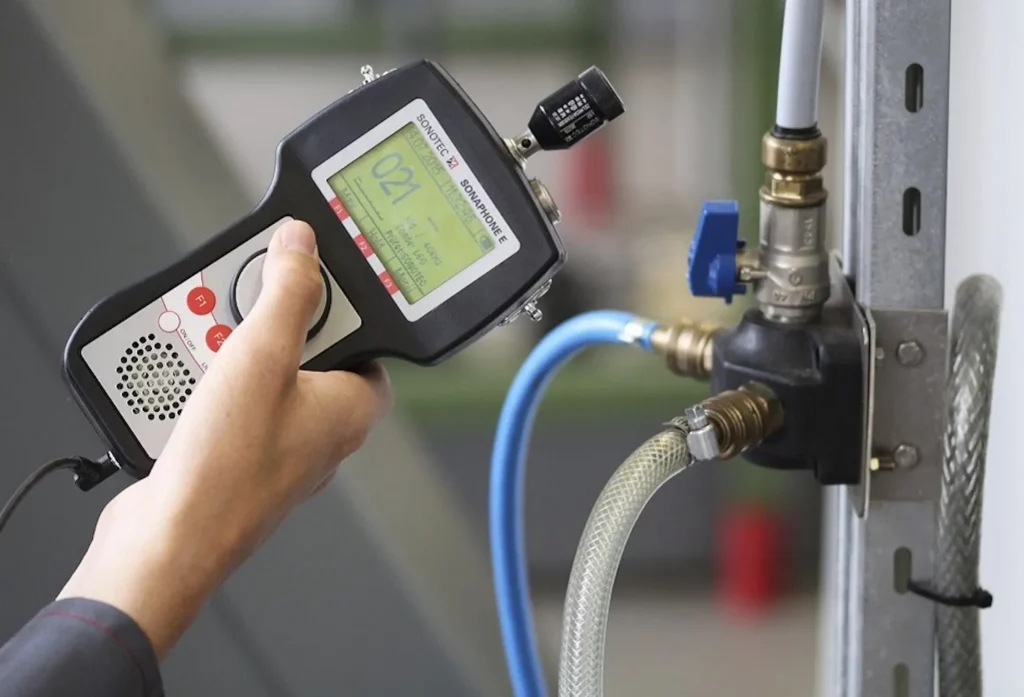
Pressurised pipes make a noise when they leak, a hiss or a rushing sound as water escapes under pressure. Acoustic detection uses highly sensitive ground microphones and correlators to listen for that sound through walls and floors and to locate where it is loudest. This is one of the most accurate methods for pinpointing leaks on pressurised supply and heating pipes, and it works without disturbing anything.
Tracer gas
For leaks that are small, intermittent or hard to isolate, tracer gas is often the decisive method. A safe mixture, typically hydrogen and nitrogen, is introduced into the drained pipework. The gas is lighter than air and escapes through the leak point, rising up through the wall to the surface where a sensitive detector picks it up. Tracer gas can find the smallest of leaks with real precision, and it is invaluable when acoustic methods are inconclusive.
Bringing it together, then one small access point
The skill is in combining these methods. Moisture mapping shows the extent, thermal imaging suggests the pipe run, acoustic detection localises the sound, and tracer gas confirms the exact point. Only once the source is confirmed does anyone open the wall, and then it is a single small, targeted access point rather than a wall torn open on a hunch. That is the entire difference between a tidy repair and a demolition job.
Our approach and what it typically costs
We work non invasively as a matter of principle, using multiple methods together rather than relying on any single tool. Our positioning is deliberately straightforward. We operate on a no find, no fee basis, so if we cannot locate your leak you do not pay for the detection. We agree a fixed hourly rate at the point of booking, so there are no surprises when the invoice arrives. And where a leak is confirmed, we provide clear, insurer ready reports documenting the findings, which matters a great deal if you intend to claim on your buildings insurance for trace and access or resulting damage.
As a guide to budgeting, typical UK trade cost guide ranges for professional leak detection sit broadly in the region of around 250 to 600 pounds for a detection survey, depending on the size of the property, the complexity of the pipework and the methods required. Tracer gas work and larger properties tend to sit towards the upper end. These are indicative ranges from published trade cost guides rather than a quote, and the fixed hourly rate we agree at booking is the rate you will actually be charged. Set against the cost of speculative demolition, redecoration and the secondary damage caused by a leak left running, professional detection almost always works out cheaper.
If you would like to understand the full process, our main leak detection in London page explains how a survey works from first call to final report.
When to act
A hidden leak does not fix itself and rarely gets cheaper to deal with. Damp spreads, plaster fails, mould takes hold, timber rots and, on heating systems, corrosion accelerates. If you have noticed any of the signs described here, do the safe checks first, resist every urge to open the wall, and get the source identified properly. Finding a leak behind a wall is entirely possible without demolition. It just needs the right methods, in the right order, applied by someone who has done it many times before.
Frequently asked questions
Can I find a leak behind a wall myself without any equipment?
You can narrow it down considerably. Reading your water meter with everything turned off tells you whether there is a supply leak, watching the boiler pressure points to heating leaks, and feeling for warm or cold damp patches and locating a musty smell helps identify the area. What you cannot do without equipment is pinpoint the exact spot inside the wall, which is why professionals use moisture mapping, thermal imaging, acoustic detection and tracer gas to locate it precisely before opening anything.
How do I know if it is a leak or just damp or condensation?
It is not always obvious from the surface, because a pipe leak, penetrating damp, rising damp and condensation can look similar. Leaks tend to produce a localised patch with a defined tide mark that grows and returns quickly after drying, often with a warm spot if it is a hot pipe. Condensation is usually more even and worse in winter on cold walls. A moisture survey settles the question by reading the pattern and gradient of the moisture, and our guide on whether a water stain is a leak or damp explains the differences in more detail.
Should I cut into the wall to look for the leak?
No. Water tracks along joists and behind plasterboard, so the visible damp is usually not where the leak actually is. Cutting there often means finding dry pipework, a fresh hole to repair, and a risk of hitting a live pipe or cable. It also destroys the moisture evidence a specialist would use to trace the source. Have the leak located non invasively first, then open a single small access point exactly where it is needed.
What methods do you use to find a leak without demolition?
We combine several non invasive techniques. Moisture mapping shows where the wall is wettest and how moisture is spreading, thermal imaging reveals temperature differences that trace pipe runs and moisture, acoustic detection listens for the sound of water escaping pressurised pipes, and tracer gas pinpoints small or intermittent leaks with real precision. Cross referencing these methods lets us locate the source accurately before any wall is opened.
How much does professional leak detection cost in London?
As a guide, typical UK trade cost guide ranges for a leak detection survey fall broadly in the region of around 250 to 600 pounds depending on the size of the property, the complexity of the pipework and the methods required, with tracer gas work and larger homes towards the upper end. We agree a fixed hourly rate at the point of booking so you know the rate in advance, and we work on a no find, no fee basis, so you are not charged for detection if we cannot locate the leak.
Will I get a report I can use for an insurance claim?
Yes. Where a leak is confirmed we provide a clear, insurer ready report documenting the findings, which is important if you intend to claim on your buildings insurance for trace and access costs or for the resulting damage. Having a professional detection report supports the claim and helps establish the cause and location of the leak.