One tile up, not the whole floor
Underfloor Heating Leak Detection
Underfloor heating leaks frighten homeowners more than any other, and understandably: the pipe is cast into the screed under your finished floor, and the nightmare scenario is digging all of it up. The reality, with proper detection, is far kinder — a UFH leak can almost always be located to a spot the size of a dinner plate.
Quick answer
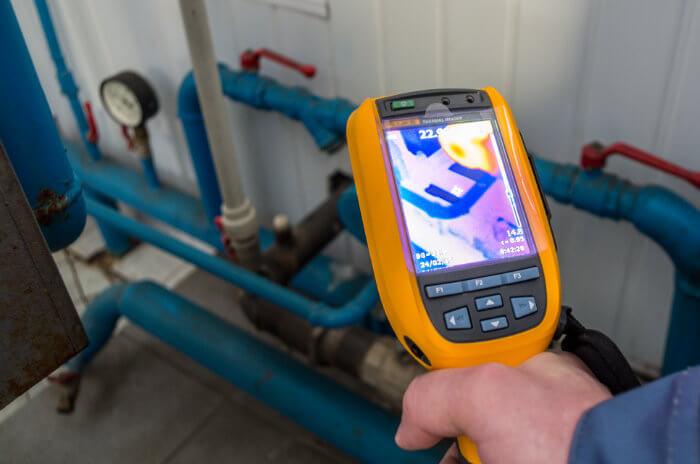
We run the underfloor heating under load and thermal image the loops, so the warm leaking pipe shows up against the cooler screed. Tracer gas and moisture meters confirm the spot, letting us pinpoint the leak to one bay and lift the minimum of floor to reach it.
Underfloor heating leak detection costs
| Job | Typical cost | Time |
|---|---|---|
| Thermal imaging survey of heated loops | £250 to £450 | 1 to 2 hours |
| Tracer gas or moisture pinpointing | £300 to £550 | 2 to 3 hours |
| Manifold pressure test and flow check | £150 to £300 | 1 to 2 hours |
| Localised floor lift to expose the pipe | £200 to £500 | 2 to 4 hours |
| Pipe repair and reinstatement | £350 to £800 | 3 to 5 hours |
Typical UK trade cost-guide ranges, not a quote. Our detection is charged at a fixed hourly rate quoted at booking, under no find, no fee.
Thermal imaging shows the whole buried loop within minutes of the system running; the leak point interrupts the pattern. Where the image needs confirming, we drain the loop and charge it with tracer gas, which rises through the screed at the exact failure point.
The repair then means lifting one small area of floor, exposing the pipe, and fitting a proper repair coupling — not excavating a room.
Fixed hourly detection rate quoted up front, no find no fee. Floor access and repair quoted once the leak is marked.
What you get
- Full loop mapping with thermal imaging
- Tracer gas confirmation through screed and tile
- Manifold and actuator fault diagnosis
- Loop-by-loop pressure testing on multi-zone systems
- Minimal, precisely-targeted floor access
- Repair couplings rated for buried UFH pipe
How it works
Tracing a leak in a buried heating loop
01
Test at the manifold
Each loop is pressure-tested individually to identify which one is losing water.
02
Image the loop
Running the zone warm paints the buried pipe onto the thermal camera.
03
Confirm with gas
Tracer gas pins the failure to centimetres before any floor comes up.
04
Open small, repair properly
A minimal opening exposes the pipe for a pressure-rated repair, then the loop is retested.
Before you book anyone
6 things to know before you book underfloor heating leak detection in London
01
Check the manifold before you pay anyone to look under the floor
A competent survey starts at the manifold, and so should you. Close every loop, then open them one at a time: the circuit that loses pressure is the culprit, which can narrow 100m² of flooring down to a single 20m² zone before anyone lifts a tile. A useful benchmark from heating engineers: with the system isolated and cooled, a drop of more than 0.3 bar in 24 hours points to a genuine leak, whereas 0.1-0.2 bar a month is normal weeping. If a company skips per-circuit pressure testing and goes straight to talk of excavation, walk away.
02
Know the going rate - and why 'cheap' hourly quotes rarely stay cheap
UK cost guides put underfloor heating leak detection at £300-£600, with thermal-only surveys from around £300-£400 and tracer gas or acoustic work at £400-£600. London firms advertising £80-£120 per hour can look cheaper on paper, but UFH detection is slow, methodical work: an open-ended hourly job across a multi-loop system can quietly outrun a fixed quote. Our model is a fixed hourly detection rate agreed at booking - typically £340–£680 in total for a London domestic visit - so the rate you accept is the rate you pay, however long the survey takes.
03
Treat 'you'll need the whole floor up' as a red flag, not a diagnosis
The most common horror story on UK forums is a plumber quoting full floor removal - or a complete system replacement - before any detection has been done. The repair reality is far less dramatic: once a leak is pinpointed, a small section of screed is lifted, a repair coupling is fitted to the pipe, and the patch is re-screeded. Compare the numbers: re-screeding an entire floor can run to £5,000 or more before new flooring, while a targeted repair is a fraction of that. Always get the leak located to within centimetres before you accept any excavation quote.
04
Ask exactly which methods they carry on the van
Thermal imaging alone is the cheapest survey to sell and the easiest to get wrong. It struggles with deep screed, insulation layers, thick tiles and engineered wood, and it only shows temperature difference - not always the leak itself. A survey that can actually pinpoint a buried pipe failure combines methods: thermal imaging to map the circuit, acoustic microphones and correlators to listen for escaping water, tracer gas (hydrogen/nitrogen) pushed through the suspect loop to surface through the floor, plus moisture mapping and per-circuit pressure tests to confirm. Ask what happens - and what you pay - if the first method finds nothing.
05
Read the no-find-no-fee small print before you book
'No find no fee' is now standard marketing, but the qualifying conditions vary wildly. Some London firms only honour it if your system is losing a measurable amount of pressure per day; others exclude intermittent leaks, or charge for the visit anyway as a 'survey fee' if nothing is found. Before booking, ask three questions in writing: what conditions void the guarantee, whether the fee covers all detection methods or just the first one tried, and whether a failed detection still generates an invoice. A genuine guarantee has a one-line answer to all three.
06
Insist on a report your insurer will actually accept
Most UK buildings policies include trace and access cover - typically £5,000-£10,000 - which pays for locating the leak and opening up the floor, though not the pipe repair itself. Loss adjusters reject claims built on a one-line invoice; they want cause and origin, method logs with readings, moisture mapping, annotated photographs and a location diagram. Claims for 'gradual seepage' or apparent wear and tear are the ones that fail, so precise evidence of a sudden pipe failure matters. We structure every trace and access report for UK loss adjusters and deliver it within 48 hours of the visit.
Compare like for like
Underfloor Heating Leak Detection Across London
A leaking underfloor heating loop can drop your system pressure and warp expensive floors long before you see damp. We trace the fault to a single bay using thermal imaging under load and circuit pressure testing, so only a small area of floor needs lifting rather than the whole room.
| What to check | A cheap hourly quote | A one-method firm | London Leak Specialist |
|---|---|---|---|
| Thermal imaging under load | May skip imaging entirely or scan cold floors, missing loops that only show a heat signature when running. | Runs a thermal survey but has no second method to confirm, so cool spots can be misread. | We image the loops with the system under load, mapping warm pipe runs and the cold break where heated water is escaping. |
| Pressure testing each circuit | Often tests the manifold as a whole, so a single leaking loop is hard to isolate from the group. | Relies on one technique alone and may not pressure test individual circuits to narrow things down. | We isolate and pressure test each loop separately, so we know which circuit has dropped and which are sound. |
| Pinpointing to one bay | Gives a rough area, which often means lifting a large stretch of floor to find the actual break. | Single-method results can leave a wider search zone than needed before the pipe is exposed. | We cross-check imaging and pressure data to mark a single bay, so digging opens the smallest possible patch. |
| Protecting floor finishes | Cutting corners on care can crack tiles, split engineered boards or lift screed beyond the leak. | Focused on locating only, with less planning for how costly finishes are lifted and reinstated. | We plan access to protect tiles, stone and engineered boards, keeping any lift neat and reversible where we can. |
| Pricing model | An open hourly rate can climb fast on a slow hunt, with the final bill unclear until it lands. | Pricing may cover their one method only, with extra visits added if it does not locate the fault. | We quote a clear fee for the trace against typical UK trade cost-guide ranges, agreed before we start. |
| No-find, no-fee | You usually pay for the hours regardless of whether the leak was actually found. | A single method that fails can still leave you charged for the attempt. | If our survey does not locate the leak, you do not pay our trace fee. The risk stays with us. |
| Insurer-ready report | Rarely provides documentation, leaving you without evidence for a trace-and-access claim. | May offer a basic note, but often lacks the images and readings insurers expect. | We supply a written report with thermal images and pressure readings to support any insurance claim. |
| Confirming the repair area | Might hand over without checking, so a missed second leak surfaces weeks later. | One method gives one view, so a nearby fault can go unnoticed until the floor is open. | We recheck pressure once the bay is exposed to confirm the break found is the only one on that loop. |
From the forums
Why underfloor jobs run longer than quoted
Underfloor heating leaks come up regularly on UK forums like MoneySavingExpert, DIYnot and the housing and DIY subreddits, and the same anxieties repeat: dreading a dug-up floor, quotes that jump straight to full replacement, and insurers who pay less than expected. Here is the consensus, paraphrased.
On MoneySavingExpert, homeowners untangling trace and access cover
The recurring confusion is what insurance actually pays for. Forum regulars keep explaining the same split: buildings cover handles the water damage, trace and access pays for finding the leak and opening up the floor, but the pipe repair itself almost always comes out of the homeowner's pocket. Several posters were caught out assuming 'escape of water' meant everything was covered. Our take: knowing this split before you claim shapes everything - it is why the detection report needs to be strong enough to unlock the trace and access element, because that is where the real floor-opening costs sit.
On DIY forums, engineers pushing manifold checks before any excavation
The most upvoted advice in almost every UFH leak thread is the same: do not let anyone near the floor until each loop has been isolated and pressure tested at the manifold. Posters describe narrowing a suspected leak from the entire ground floor to one circuit in under an hour, and others warn about tradesmen who never opened the manifold cabinet before quoting. Our take: this instinct is exactly right - per-circuit pressure testing is the first thing we do on site, because it turns a whole-house problem into a single-room one before any specialist kit comes out.
On housing forums, people quoted full floor or system replacement
A steady stream of posts describes plumbers who, faced with a pressure-losing UFH system, quote wholesale floor removal or abandoning the system entirely - sometimes five-figure sums. The community response is consistently to get a second opinion from a detection specialist first, and follow-up posts often report the leak was pinpointed and repaired through a small opening for a fraction of the quote. Our take: general plumbers without detection equipment can only offer excavation; a multi-method survey exists precisely so the digging happens in one small place, once.
On money and housing forums, insurer cash settlements falling short
Posters who accepted a loss adjuster's cash settlement frequently report it covered less than half the real reinstatement cost, especially where matching flooring ran through several rooms - insurers typically contribute only partially to undamaged matching areas. The advice given is to document everything, challenge low offers, and never rely on a bare invoice as evidence. Our take: the quality of the detection report directly affects the settlement; cause, origin, moisture mapping and photographs give a loss adjuster far less room to trim the claim than a scribbled job sheet does.
On DIY forums, the £20 leak sealer temptation
Threads about small UFH pressure drops often surface the same shortcut: a bottle of internal leak sealer costing around £20, dosed through the manifold. Some report it holding for years on pinhole leaks; others describe it failing within months, and experienced posters warn it can gum up flow meters and, crucially, mask the evidence of a sudden pipe failure that an insurance claim depends on. Our take: sealer is a gamble, not a repair - if there is any chance you will claim on trace and access, locate and document the leak properly before putting chemicals through the system.
Questions
Underfloor heating leaks: finding them without breaking the screed
Will you have to dig up my whole floor?
No — that is precisely what detection prevents. Once the leak is located, the opening is typically a single tile or a small square of screed directly above the failure. The rest of the floor is never touched.
How do UFH pipes fail in the first place?
Most failures are mechanical: a screw or nail through the pipe during later work, damage at installation that took years to fail, or a poorly-made joint buried against the rules. The pipe material itself rarely fails spontaneously.
My UFH pressure drops but the floor never feels wet — why?
Screed absorbs a remarkable amount of water before anything reaches the surface, and heated floors dry themselves from above. Pressure loss is usually the only early symptom, which is why it should never be ignored.
Can a repaired UFH loop be trusted long-term?
Yes, when done properly. Press-fit repair couplings rated for buried use restore the loop to full pressure rating, and we retest the circuit before the floor is closed.
How much does underfloor heating leak detection cost in the UK?
We charge a fixed £200 an hour for heating and underfloor work, and a multi-loop trace usually takes two to four hours, so £400–£800 in total. Across the trade: UK cost guides put underfloor heating leak detection at £300-£600. Thermal-imaging-only surveys start around £300-£400, while surveys using tracer gas or acoustic equipment typically run £400-£600. Beware open-ended hourly rates of £80-£120: multi-loop systems take hours to test properly, so hourly billing often exceeds a fixed quote. Detection is usually reclaimable under trace and access insurance cover.
Can an underfloor heating leak be repaired without digging up the whole floor?
Yes, in almost all cases. Once the leak is pinpointed - using per-circuit pressure testing, thermal imaging, acoustic detection and tracer gas - only a small section of screed above the failure is lifted. A repair coupling is fitted to the pipe, the system is retested, and the patch is re-screeded. Full floor removal is only justified when a system has multiple failures, which detection confirms or rules out before anyone commits to excavation.
How do I know if my underfloor heating is leaking?
The classic signs are a boiler or manifold that keeps losing pressure, unexplained warm or damp patches on the floor, lifting flooring, or a heating zone that stops performing. To confirm, isolate the underfloor circuits at the manifold and watch the gauge: a drop of more than 0.3 bar in 24 hours on a cooled, isolated system indicates a leak, whereas 0.1-0.2 bar a month is normal. Closing loops one at a time identifies which circuit is losing water.
Does home insurance cover underfloor heating leaks?
Usually in part. Buildings insurance covers water damage from an escape of water, and most policies include trace and access cover - typically £5,000-£10,000 - which pays for locating the leak and opening up the floor. The repair to the pipe itself is normally excluded, and claims for gradual seepage or wear and tear are commonly rejected. A detailed detection report showing cause, origin, readings and photographs is what loss adjusters expect before approving trace and access costs.
How long does underfloor heating leak detection take?
Most domestic underfloor heating surveys take two to four hours. The engineer isolates and pressure tests each circuit at the manifold first, then uses thermal imaging, acoustic equipment and tracer gas on the suspect loop to pinpoint the failure, usually to within centimetres. Larger properties, multiple manifolds or intermittent leaks can extend this to a full day, which is why a fixed hourly rate agreed in advance protects you better than an hourly rate.
Should I use leak sealer on an underfloor heating leak?
Only as a last resort on a confirmed pinhole leak, and never before an insurance claim. Internal leak sealers (around £20 a bottle) can seal tiny weeps, but results are inconsistent on underfloor circuits, the chemicals can clog manifold flow meters, and sealing the leak destroys the evidence a trace and access claim relies on. If the system is losing measurable pressure daily, professional detection and a targeted pipe repair is the durable fix.
London-wide
Boroughs we cover for underfloor loops
Related services
Thermal Imaging
Infrared thermal imaging surveys find hidden water and heating leaks in London homes without opening floors or walls.
Learn moreTracer Gas
Tracer gas leak detection in London finds the leaks acoustic and thermal methods cannot: deep, small or slow leaks under concrete floors and external grounds.
Learn moreHeating Leaks
Boiler losing pressure? We find central heating leaks under floors, in walls and behind radiators across London, with the fee agreed before we travel to you.
Learn moreCold patch in a warm floor?
Tell us the symptoms and your postcode. We’ll confirm the visit, the fixed hourly rate, how long we expect to need and the arrival window before you commit to anything.
Book a detection visit