Basements and lower-ground floors are the hardest place in a London home to diagnose water. Here is why they are so tricky, how to tell groundwater from a live plumbing leak, and how professionals separate the two before anyone spends thousands on tanking or new pipes.
A damp patch on a basement wall is one of the most misdiagnosed problems in a London home. The same brown stain, the same musty smell and the same wet skirting can be caused by three completely different things: water pushing in through the structure from the ground outside, moisture rising or penetrating through porous masonry, or a live leak from a pipe hidden in the floor or wall. Each has a different fix, and the fixes are not cheap. Tanking a cellar or replacing a section of buried drainage can run into thousands of pounds, so the worst outcome is paying for the wrong one and watching the damp come back within months.
London makes this harder than almost anywhere else in the country. The city sits on layers of clay, gravel and made ground, criss-crossed by old brick sewers, Victorian clay drains and water mains that are often more than a century old. Add tens of thousands of converted basements and dug-out lower-ground floors, some with basement pools and spas, and you have a perfect environment for water to appear where you least expect it. This article explains why basements are so difficult, how to read the symptoms, and how a proper multi-method survey separates a groundwater problem from a genuine plumbing leak before you commit to expensive work.
Why Basements and Cellars Are So Difficult to Diagnose
Above ground, most leaks announce themselves clearly. A ceiling stain sits below a bathroom, a wet patch tracks along a visible pipe run, and gravity does you the favour of pointing downward. Below ground, none of that applies. You are surrounded on all sides by earth, the water can arrive from any direction including straight up through the slab, and the structure itself is often holding back a standing body of moisture in the surrounding soil.
You may be below the water table
The water table is the level below which the ground is saturated. In parts of London, particularly near the Thames, its tributaries and the many buried rivers such as the Fleet and the Tyburn, that level can sit close to the surface and rise sharply after heavy or prolonged rain. A basement floor that is dry all summer can start weeping in November simply because the surrounding ground is now waterlogged and pressing against the structure. This is hydrostatic pressure, and it will exploit any weakness in the walls or slab. Crucially, it has nothing to do with your plumbing.
Old drains and mains run close by
London basements are frequently within a metre or two of Victorian clay drainage, shared sewers and ageing water mains. Clay drains crack, their joints open up, and tree roots find their way in. A cracked drain running past or under a basement can release a steady trickle of water into the ground right next to the wall, which then migrates through the masonry and looks for all the world like rising damp or a tanking failure. A weeping mains connection does the same thing. The leak is real, but it is not inside the room, which is exactly why guesswork fails.
Tanking and membranes fail in predictable places
Most converted London basements rely on either a cementitious tanking system applied to the walls, or a cavity drain membrane, the dimpled plastic sheeting that channels any incoming water down to a drainage channel and a sump. Both work well when installed correctly and both fail in predictable ways. Tanking fails at junctions, service penetrations and where the slab meets the wall. Membranes fail when the drainage channel silts up, when the sump pump stops working, or when a penetration is made through the membrane for a new pipe or radiator and not sealed. A tanking failure lets ground water in; it does not create it.
Pumped drainage adds a moving part
Many lower-ground floors cannot drain to the sewer by gravity, so they rely on a sump and pump, or a packaged pumping station, to lift waste and groundwater up and out. That pump is a single point of failure. If it clogs, sticks or loses power, water backs up and the floor floods, and the homeowner understandably assumes a burst pipe. A blocked pump discharge or a failed float switch can perfectly mimic a plumbing emergency.
Groundwater and Penetrating Damp Versus a Live Pipe Leak
The single most valuable thing a survey establishes is whether you are looking at water from the ground or water from a pipe. Get this wrong and every pound spent afterwards is at risk. The distinction matters because a live pipe leak is usually a contained, fixable fault, whereas groundwater ingress is an ongoing environmental condition that has to be managed rather than simply patched.
There are honest, practical clues, and the community consensus on forums such as r/DIYUK and r/HousingUK reflects what experienced surveyors see every week. The recurring themes in those discussions are worth stating plainly: damp that tracks the weather almost always points to groundwater rather than plumbing; clean, odourless water that keeps coming back is more likely to be mains or ground water than a waste leak; and the strong, repeated advice is to get an actual diagnosis before authorising any tanking or excavation, because a large share of people who paid for a fix on assumption found the problem returned. None of that replaces a survey, but it aligns with the professional method.
Reading the water itself
The character of the water tells a story. A live leak from a heating system may be slightly discoloured or leave a mineral residue and can feel warm near the source. Mains water is clean and cold and can flow steadily regardless of rainfall. Groundwater is often cool, may carry a faint earthy or musty smell, and characteristically waxes and wanes with the weather and the seasons. Waste or drainage leaks tend to carry an odour and may appear only when appliances upstairs are used.
Symptom to Likely Cause
| What you observe | More likely cause | Why |
|---|---|---|
| Damp worsens after heavy rain or in winter, dries in summer | Groundwater or penetrating damp | Water table and saturated soil pressing on the structure |
| Wet patch stays constant regardless of weather or usage | Live mains or heating leak | Pressurised supply feeds water continuously |
| Damp appears only when a bathroom or kitchen upstairs is used | Waste or supply pipe leak above | Fault only releases water under load |
| Musty smell, tide marks low on the wall, salts on the surface | Penetrating or rising damp | Slow migration of ground moisture through masonry |
| Sudden flooding of the floor, water rising from the slab | Failed sump pump or blocked drainage | Pumped system has stopped clearing water |
| Warm damp patch, boiler pressure dropping | Live heating leak | Sealed system losing water into the structure |
| Clean water pooling near a service entry point | Leaking mains or supply penetration | Incoming pipe or its seal has failed |
| Damp isolated to one junction or corner after building work | Tanking or membrane defect | Waterproofing breached at a detail or penetration |
How Professionals Separate the Two
A credible basement survey is deliberately non-invasive and uses several methods together, because no single instrument gives the whole answer underground. The aim is to build a consistent picture from independent lines of evidence before anyone lifts a slab or opens a wall. This is the same disciplined approach we apply across all of our leak detection in London work, adapted for the specific challenges of below-ground rooms.
Moisture mapping and thermal imaging
The survey usually begins with calibrated moisture meters and a thermal imaging camera. Moisture mapping records readings systematically across walls and floors to find where the material is genuinely wet rather than merely cold to the touch, and to trace the moisture back towards its wettest point. Thermal imaging reveals temperature differences that can indicate the path of water or the presence of a warm heating leak behind a finish. Neither is conclusive on its own, but together they narrow the search area and, importantly, show whether the moisture pattern matches a pipe run or a general ground-facing surface.
Tracer gas through service penetrations
When a live leak is suspected, tracer gas is one of the most reliable tools available. A safe hydrogen and nitrogen mixture is introduced into the suspect pipework; being far lighter than air, the gas escapes at the exact point of the leak and rises to the surface, where a sensitive detector picks it up. In a basement, tracer gas is especially useful because it can be tracked through service penetrations, the points where pipes and cables pass through the structure, to confirm whether water is entering along a pipe route or through the fabric of the wall itself. This is the heart of a proper trace and access survey: pinpointing the source precisely so that any opening up is minimal and targeted rather than exploratory.
Acoustic and pressure testing
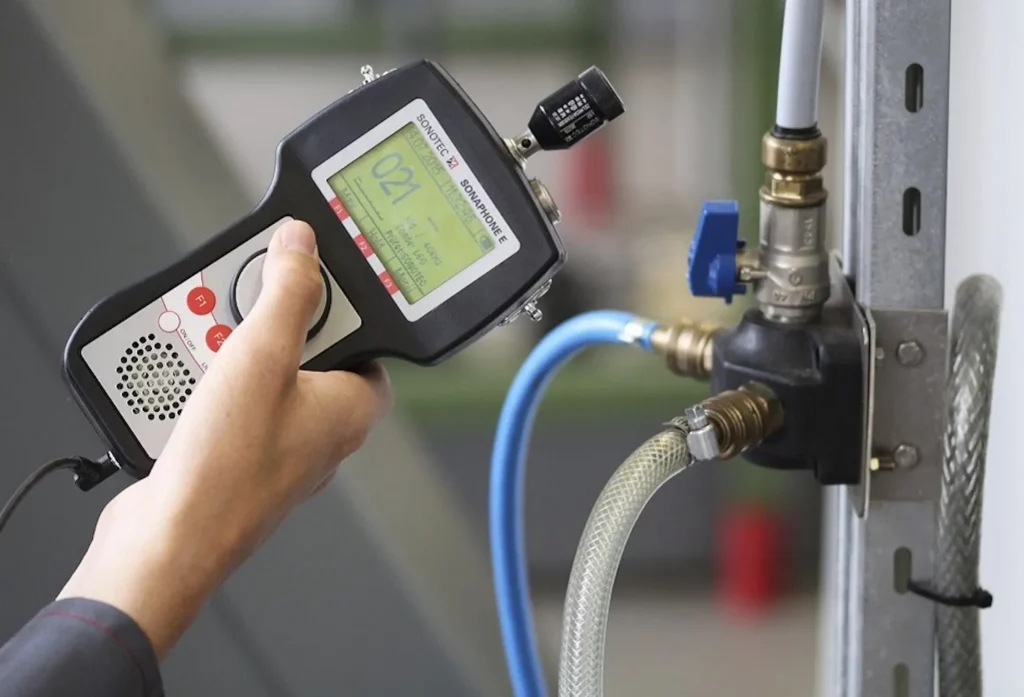
Acoustic listening equipment amplifies the sound of water escaping under pressure, which is highly effective for mains leaks even under a concrete floor. Pressure testing isolates a section of pipework and monitors whether it holds; a falling pressure confirms a live leak and helps distinguish supply from heating from waste. Combined with the moisture map, this quickly rules a plumbing leak in or out.
Camera surveys of drainage and land drains
If drainage is in the frame, a CCTV drain camera is sent through the pipes and any land drainage around the property. This finds cracked clay drains, displaced joints, root ingress and blockages that could be feeding water into the ground beside the basement. It also confirms whether a sump and pump system is discharging correctly. A drainage camera survey often solves cases that had been wrongly blamed on the walls for years.
Putting the evidence together
The value of the multi-method approach is cross-confirmation. If moisture mapping, tracer gas and pressure testing all agree that a copper pipe under the slab is leaking, that is a plumbing repair and tanking would have been a waste of money. If the water tracks the weather, the pipes hold pressure, the drains are sound and the moisture is spread evenly across the ground-facing wall, the problem is groundwater and the right conversation is about waterproofing and drainage, not pipes. Only when the diagnosis is settled does it make sense to talk about the fix, whether that is a repair, a new membrane, a pump or tanking.
What This Costs and How Our Pricing Works
Understanding money up front avoids nasty surprises. As a general guide, typical UK trade cost-guide ranges put a professional non-invasive leak detection survey in the region of a few hundred pounds, commonly around 300 to 600 pounds depending on scope and access. Trace and access work that involves careful opening up sits on top of that. On the repair side, remedial tanking or a cavity drain membrane system for a basement is typically quoted in the low thousands, often 3,000 to 8,000 pounds or more for a full room, while replacing a section of cracked buried drainage varies widely with depth and access. These are indicative ranges to help you budget, not quotes, and every London basement is different.
Our own position is deliberately straightforward. We use a non-invasive, multi-method survey precisely so that we can tell groundwater apart from a live leak before anyone spends money on the wrong remedy. We work on a no find, no fee basis for leak detection, and we agree a fixed hourly rate at the point of booking so you know the rate before we arrive. There are no hourly surprises and no pressure to authorise expensive tanking on a hunch. If the honest answer is that your problem is groundwater rather than a plumbing leak, we will tell you, because getting the diagnosis right is the whole point.
What You Can Do Before the Survey
A few observations from you make the survey faster and sharper. Note whether the damp changes with the weather, whether it appears when specific taps or appliances are used upstairs, and whether your boiler pressure is dropping. Check your water meter with everything turned off; if it still creeps, you may have a live supply leak. Photograph the damp over several days so the pattern is on record. If you have a sump pump, listen for it cycling and note whether it seems to run constantly or not at all. If you want to work through the logic yourself first, our guide on how to tell damp from a leak walks through the same questions a surveyor asks.
The temptation with a wet basement is to act fast and simply tank the walls, because doing something feels better than doing nothing. In a London lower-ground floor, that instinct is exactly what leads to wasted money and recurring damp. The water below your feet is rarely simple, and the only reliable way forward is to diagnose before you dig. Establish whether it is the ground or a pipe, prove it with more than one method, and then, and only then, pay for the fix.
Frequently asked questions
How can I tell if my basement damp is groundwater or a real pipe leak?
The clearest early clue is timing. Groundwater and penetrating damp usually change with the weather, getting worse after heavy rain and in winter and easing in summer, because they depend on the water table and saturated soil. A live pipe leak tends to stay constant regardless of weather, or only appears when specific taps and appliances are used. Clean, cold water that keeps returning can point to mains or ground water, while warm or discoloured water and a dropping boiler pressure suggest a heating leak. None of these are conclusive on their own, which is why a multi-method survey is used to confirm the source before any repair.
Should I tank my cellar to stop the damp?
Not until you know what is causing the damp. Tanking and cavity drain membranes manage water that is genuinely coming from the ground, but they do nothing for a live plumbing leak and can even trap it. If the real problem is a cracked drain, a leaking mains pipe or a failed pump, tanking will simply hide it for a while before the damp returns. Diagnose first with moisture mapping, tracer gas, pressure testing and, where relevant, a drain camera. Only commit to tanking once the survey has ruled a plumbing leak out and confirmed groundwater as the cause.
Why are London basements especially prone to water problems?
London sits on clay, gravel and made ground, with a water table that can rise close to the surface near the Thames and the city's many buried rivers. Basements are often below that level after heavy rain, so groundwater presses against the structure. They are also surrounded by ageing Victorian clay drains and old water mains that crack and weep into the soil nearby. Add the huge number of converted and dug-out lower-ground floors relying on tanking, membranes and pumps, and you have many ways for water to appear, which is exactly why careful diagnosis matters more here than almost anywhere else.
Is leak detection in a basement invasive or messy?
A proper survey is designed to be non-invasive. Moisture mapping, thermal imaging, acoustic listening, tracer gas and drain cameras all gather evidence without demolition. The purpose of pinpointing the source so precisely is to keep any opening up to an absolute minimum, so that if a wall or slab does need to be accessed, it is one small targeted area rather than an exploratory dig. This trace and access approach protects your finishes and saves money compared with guesswork that involves ripping out large sections in the hope of finding the fault.
What does basement leak detection cost, and what is your no find no fee policy?
As a general guide, typical UK trade cost-guide ranges put a professional non-invasive leak detection survey at roughly 300 to 600 pounds depending on scope and access, with trace and access work on top if opening up is needed. We agree a fixed hourly rate at the point of booking, so you know the rate before we arrive and it cannot rise on the day. Our leak detection is offered on a no find, no fee basis. These figures are indicative to help you budget rather than a quote, since every basement differs in size, access and construction.
Could my flooded basement floor be a failed pump rather than a burst pipe?
Yes, and it is a common mix-up. Many lower-ground floors cannot drain to the sewer by gravity, so they rely on a sump and pump to lift water out. If that pump clogs, sticks or loses power, or if its float switch fails, water backs up and the floor floods in a way that looks exactly like a burst pipe. Part of the survey is checking whether the pumped drainage is working and whether the discharge is clear, using a drain camera if needed. Confirming this early prevents an unnecessary hunt for a plumbing leak that is not there.