Washing Machine Leaking? Dishwasher Leaks? Causes and Fixes
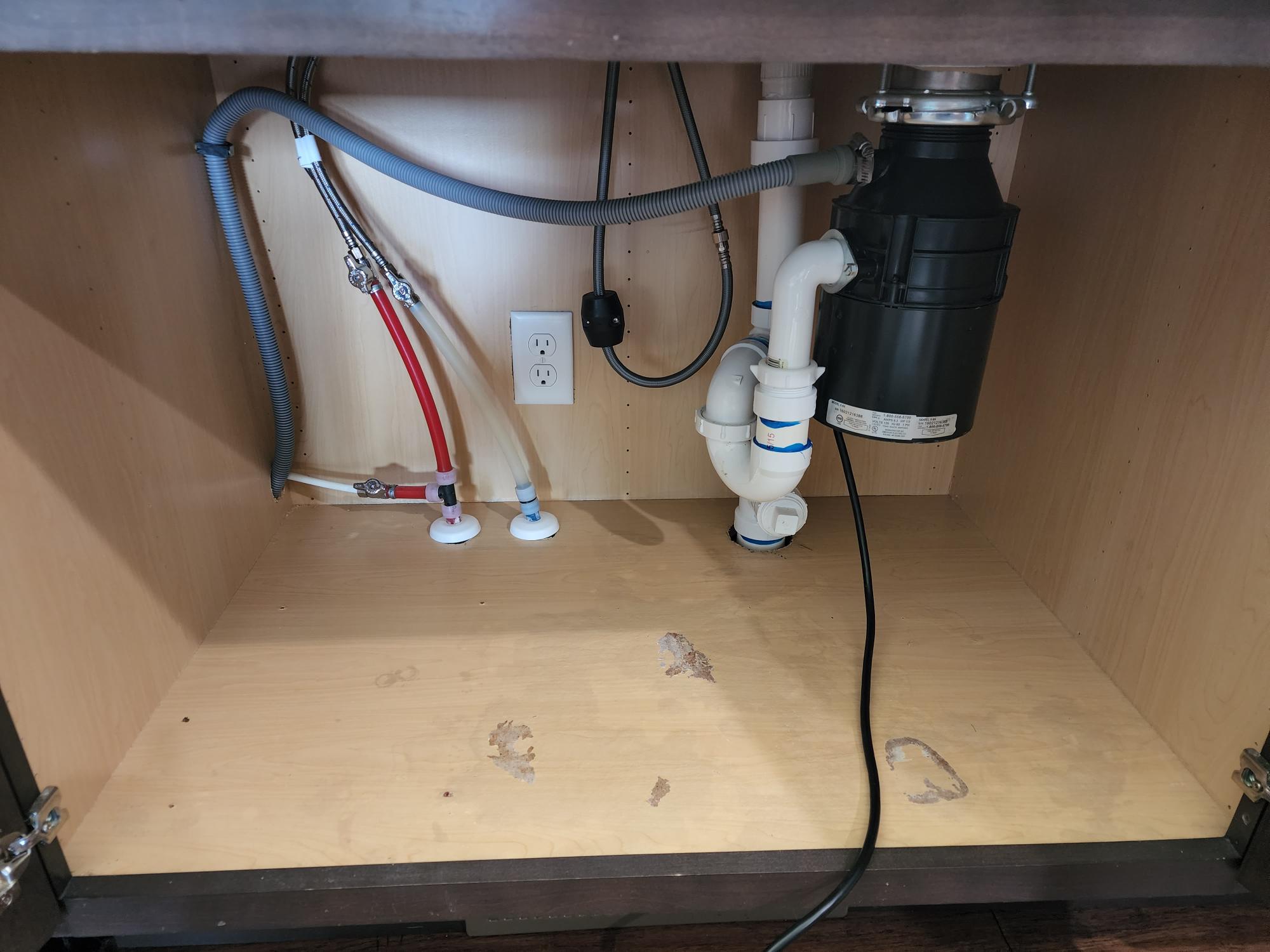
Water pooling under your washing machine or dishwasher is one of the most common kitchen emergencies. Here is where these appliances leak, how to stop the water safely, why a burst flexi-hose can flood a whole room, and how to tell an appliance fault from a plumbing problem behind the unit.
Few things get a household moving faster than the sight of water spreading across the kitchen floor from under an appliance. A washing machine leaking onto the kitchen floor, or a dishwasher doing the same, rarely announces itself politely. Often the first sign is a damp patch at the edge of a plinth, a musty smell, or water creeping out from beneath the units when a cycle is running. Because both appliances sit tight against pipework, tucked under a worktop and hidden behind a kickboard, it can be genuinely difficult to work out whether the appliance itself has failed or whether the plumbing serving it is at fault.
This guide walks through the places these machines commonly leak, the immediate steps that protect your home, why a burst flexible hose is one of the biggest single causes of serious kitchen flooding, and how to decide whether you need a plumber or an appliance engineer. The aim is to help you act calmly, limit the damage, and avoid paying for the wrong kind of visit.
First, the safety point that matters most
Washing machines and dishwashers combine water and mains electricity in a small space. If water has reached a plug socket, an extension lead, or the base of the appliance where the electrics live, treat it as a hazard rather than an inconvenience. Do not stand in a pool of water and reach for a switch that is wet. If you can safely reach your consumer unit (the fuse board), turn off the circuit powering the kitchen sockets before you start mopping around the machine.
Modern homes have a residual current device (RCD) that should trip if water bridges a live part, but you should never rely on it as your first line of defence. If you see scorching, smell burning, or hear buzzing from the appliance or a nearby socket, keep clear and get an electrician or emergency plumber to assess it before the appliance is used again. Water near electrics is the one part of this job where it is always better to be over-cautious.
Where washing machines and dishwashers actually leak
Although the two appliances look different, they plumb in almost identically. Both take cold water in through a hose, both drain waste water out through another hose, and both rely on a door or lid seal to keep water inside during a cycle. That means the leak points are broadly the same, and once you know them you can usually narrow down the source before anyone lifts a spanner.
The fill hose and the flexi-hose to the tap
Clean water enters the machine through a fill hose connected to an isolating valve under or near the sink. On many installations there is also a braided flexible hose, sometimes called a flexi-hose or flexi-tail, linking the appliance valve to the water supply. These hoses are under constant mains pressure whenever the valve is open, which is most of the time. A weep at the threaded connection usually shows up as a slow drip and a limescale crust around the fitting. A failure of the hose itself is far more dramatic, and we cover that in its own section below because it deserves the attention.
The drain hose and the waste connection
Dirty water leaves the machine through a corrugated drain hose that connects either to a spigot on the sink waste trap or to a standpipe. Leaks here tend to appear only when the machine pumps out, so you might see water arrive in a rush partway through a cycle and then stop. Common causes are a drain hose that has worked loose from its connection, a perished or missing rubber seal on the waste spigot, or a jubilee clip that has slackened over time. Because this water is grey and often carries detergent or food residue, the smell is usually a giveaway.
The door seal or lid gasket
On a front-loading washing machine, the rubber door boot seals the drum against the door glass. Over years of use it collects grit, coins, and detergent scum, and it can tear or distort so that water escapes at the front during the wash. On a dishwasher, the door gasket runs around the inside of the door. If water trickles down the front of the cabinet door onto the floor, a failed or dirty seal is a prime suspect. Sometimes the fix is nothing more than a thorough clean; sometimes the seal needs replacing.
The pump and the blocked filter
Both appliances have a pump that moves water out, and most have a filter that catches debris before it reaches the pump. In a washing machine this is usually a screw-out filter behind a small flap at the bottom front. In a dishwasher it is a cylindrical filter sitting in the base of the tub. A blocked filter makes the machine work harder and can force water past seals it would normally hold back. A failed pump, or a small object such as a hair grip or a shard of glass lodged in the impeller, can crack the pump housing and produce a leak that appears low down and towards the middle of the machine.
The split fill hose that floods under the units
This is the one that turns a nuisance into an emergency. When a fill hose or flexi-hose splits while under mains pressure, water does not drip; it sprays. Because the failure is hidden behind the appliance and below the worktop, the water runs straight down behind the kickboard and spreads under the base units before anyone notices. People frequently discover it only when water appears two or three cabinets away, or in the room below in a flat. By then the chipboard carcasses of the units may already be swelling, and a downstairs ceiling may be at risk.
Washing machine leaking now: what to do the moment you see water
The order you do things in matters. Stopping the flow comes first, making the area safe comes second, and working out the cause comes third. Here is a sequence that works for most households.
- Isolate the appliance. Behind or under the machine there should be one or two small isolation valves on the supply pipes, often with a lever or a slotted screw head. Turn the lever a quarter turn so it sits across the pipe, or turn the screw until it stops. This cuts the clean water feed to that appliance only. If you cannot find or reach the valve, turn off your main internal stop tap, which is often under the kitchen sink or near where the water enters the property.
- Switch the appliance off and unplug it, but only if it is safe. Turn the machine off at its own switch, then at the wall socket, then remove the plug. If the socket or plug is wet, do not touch it; go to the consumer unit and turn off the relevant circuit instead.
- Stop the cycle and let it drain if you can. A washing machine mid-cycle may hold a drum full of water. If the control panel still works, select a spin or drain programme to pump the water out through the proper route rather than onto the floor.
- Contain and soak up the water. Towels, a mop, and a bucket will limit how far the water travels. Lift the kickboard plinth away if you can, because water often hides behind it and will keep wicking into the units if left.
- Pull the appliance forward gently, if the connections allow. With the water isolated, easing the machine out gives you a view of the hoses and connections and lets the floor dry. Take care not to stretch or kink the hoses, and watch for a taut electrical lead.
- Photograph what you find. A couple of photos of the wet connection, the hose, or the pooling helps whoever attends, and is useful if you later make an insurance claim.
Why burst flexi-hoses are a major cause of flooding
Braided flexible hoses have become the standard way to connect appliances, taps, and toilets to the water supply because they are quick to fit and cope with slight misalignment. The trade-off is that they do not last forever. The hose is a rubber tube inside a woven stainless steel sleeve. Over years, the rubber ages and the steel braid can corrode, particularly in a damp cupboard under a sink. When the braid frays and the rubber gives way, the hose can fail without warning, and because it is always under full mains pressure it releases a large volume of water very quickly.
Home maintenance forums and communities such as r/DIYUK and r/HomeMaintenance return to this subject repeatedly, and the general consensus there mirrors what plumbers see on the ground: flexi-hose failures are one of the most common sources of significant escape-of-water damage in kitchens and bathrooms, and the damage is often severe precisely because the hose is hidden and the failure happens while nobody is home. The recurring practical advice from those communities is sensible and worth repeating. Inspect the braided hoses behind and under your appliances now and then for rust spots, kinks, or bulging. Treat them as a wear item rather than a permanent fitting. And where a hose is old, weeping, or showing rust, replace it before it fails rather than after.
It is worth being honest about the limits of prevention. A hose can look fine and still be near the end of its life, because the rubber degrades on the inside where you cannot see it. That is exactly why isolating the appliance supply when you go away for more than a day or two is a small habit that prevents a disproportionate amount of grief.
Leak source, likely cause, and what to do
The table below summarises the common leak points so you can match what you are seeing to a probable cause and a sensible first action.
| Leak source | Likely cause | What to do |
|---|---|---|
| Fill hose or flexi-hose to the tap | Aged rubber, corroded braid, or a loose threaded connection under mains pressure | Isolate the appliance valve immediately. Replace a split or rusted hose; re-seat and gently tighten a weeping connection. |
| Drain hose or waste connection | Hose worked loose, perished spigot seal, or a slack jubilee clip | Only leaks when pumping out. Refit the hose securely and replace worn seals or clips. |
| Door boot or door gasket | Torn, distorted, or dirty seal letting water escape at the front | Clean thoroughly first. If water still escapes, the seal needs replacing. |
| Pump housing | Cracked housing or an object jammed in the impeller | Water appears low and central. Usually an appliance engineer job to open and repair. |
| Blocked filter | Debris forcing water past seals it would normally hold | Switch off, place towels down, and clean the filter following the manual. Often a quick fix. |
| Split fill hose flooding under units | Hidden hose failure spraying behind the kickboard | Isolate the supply or the main stop tap at once, pull the plinth, and soak up hidden water fast. |
| Pipework or valve behind the unit | Failed isolation valve, compression joint, or waste pipe (a plumbing fault, not the appliance) | Isolate the supply and call a plumber. This is not something an appliance engineer will handle. |
Is it the appliance, or the plumbing behind it?
This is the question that decides who you should call, and getting it right saves you a wasted visit. The distinction sounds technical but it usually comes down to a few observations you can make yourself.
Signs it is the appliance
If the leak only appears when the machine is running, and specifically at a particular point in the cycle, the appliance is the likely culprit. Water that arrives during fill points to the intake side; water that arrives during the pump-out points to the drain side or the pump. Leaks from the front of the door, a smell of detergent, or a puddle that forms only after you have run a wash all point back to the machine itself. A filter you have never cleaned, or a door seal caked in scum, are appliance matters.
Signs it is the plumbing
If water is present even when the appliance is switched off and idle, the supply pipework behind it is the more likely source. A failed isolation valve, a weeping compression joint, or a corroded section of pipe will leak under standing mains pressure regardless of whether the machine is doing anything. Damp that appears at the wall behind the unit rather than at the machine, or a waste pipe that drips when the sink is used and not just when the appliance drains, points at the plumbing. In these cases the appliance is an innocent bystander, and swapping it out or calling an appliance engineer will not solve the problem.
There is a practical grey area worth naming. The flexi-hose and the isolation valve sit right at the boundary between appliance and plumbing. A plumber will happily replace a failed hose or valve, and that is usually the right call because those parts are about water supply rather than the mechanics of the machine. If the fault is inside the cabinet of the machine, at the pump, the internal hoses, the control board, or the door mechanism, that is appliance-engineer territory. When you are unsure, describing exactly when the water appears is the single most useful thing you can tell whoever you ring.
When to call a plumber versus an appliance engineer
Call a plumber when the problem is about water getting to or away from the machine: a burst or weeping flexi-hose, a failed isolation valve, a leaking compression joint, a cracked or blocked waste pipe, or any leak that continues while the appliance is off. A plumber is also the right call for the emergency itself, because stopping an active flood and drying out the supply side is exactly the kind of work covered by our emergency plumber in London service. If the water has spread beyond the kitchen or is coming through a ceiling, that has become a wider escape-of-water situation, and our guidance on water leak repair in London covers how those jobs are traced and put right.
Call an appliance engineer when the fault is inside the machine: a failed pump, a torn door seal, a cracked internal hose, a faulty water inlet valve on the appliance, or an electronic fault causing overfilling. If the machine is still under manufacturer warranty, contact the manufacturer first, because opening it yourself or having an independent engineer do so can affect the cover.
Because a leaking appliance so often sits right next to the sink, the two problems overlap in practice. If you have found water pooling in the base unit and are not certain whether it is coming from the machine or the pipework under the sink, our walkthrough on what to do about a leak under the kitchen sink helps you separate the two and decide your next step.
What the trade typically charges
It helps to have a rough idea of costs before you pick up the phone, if only so you can recognise a fair quote. As a general guide based on typical UK trade cost-guide ranges, replacing a flexi-hose or an isolation valve is usually a modest job in the region of tens of pounds for the part plus labour, often completed within a single short visit. Tracing and repairing a hidden supply leak behind units takes longer and costs more because access and drying are involved. Appliance repairs such as a pump or a door seal vary widely by make and model, and on an older machine the repair can approach the cost of replacement, which is a judgement call worth discussing openly with the engineer.
We think prices should be clear before anyone travels, not sprung on you at the door. When you call us we talk through what you are seeing, give you an honest arrival window rather than a vague promise, and agree the price with you before we set off. If it turns out the fault is inside the appliance rather than the plumbing, we will tell you that too, so you are not paying a plumber to do an appliance engineer's job.
Reducing the risk of the next leak
A little routine attention goes a long way with these appliances. Clean the washing machine filter every few months and check pockets before a wash to keep coins and grit out of the pump. Wipe the door seal and leave the door ajar between washes so it dries rather than harbouring scum. Run a hot maintenance wash occasionally to clear detergent build-up. For dishwashers, clear the filter regularly and check that the spray arms are not clogged. And once or twice a year, pull each appliance forward far enough to look at the braided hoses behind it for rust, bulging, or damp around the connections. If a hose looks tired, replacing it is cheap insurance against a flood that could cost a great deal more.
The single most valuable habit, though, is knowing where your isolation valves and main stop tap are before you ever need them. In the middle of a leak, thirty seconds spent turning off the water is the difference between a mopped floor and a ruined kitchen.
Frequently asked questions
Why is my washing machine leaking only when it drains?
A leak that appears only during the pump-out phase points to the drain side of the machine rather than the water supply. The usual causes are a drain hose that has worked loose from the sink waste or standpipe, a perished rubber seal on the waste spigot, or a slackened jubilee clip. Switch the machine off, put towels down, and check the drain hose connection is secure and the seal is intact. If the water appears low down and central instead, the pump housing may be cracked, which is a job for an appliance engineer.
How do I know if it is the appliance leaking or the pipes behind it?
The simplest test is timing. If water only appears while the machine is running, the appliance is the likely source. If water is present even when the machine is switched off and idle, the supply pipework or an isolation valve behind the unit is more likely, because those leak under standing mains pressure regardless of what the machine is doing. Telling whoever you call exactly when the water appears is the most useful single piece of information you can give them.
Why is a burst flexi-hose such a serious problem?
A braided flexible hose is under full mains pressure whenever the appliance valve is open, which is nearly all the time. When the rubber inside fails, it does not drip; it releases a large volume of water quickly, and because the hose is hidden behind the appliance the water runs down behind the kickboard and spreads under the units before anyone notices. In a flat it can reach the property below. That combination of high flow and hidden location is why these failures cause so much damage.
Is it safe to touch a leaking appliance that is still plugged in?
Only if the water has not reached the socket, the plug, or the electrics at the base of the machine. Water and mains electricity together are a genuine hazard. If the socket or plug is wet, or if you would have to stand in water to reach the switch, do not touch it. Instead, turn off the relevant circuit at your consumer unit, or the main switch, before you go near the appliance. If you smell burning or see scorching, keep clear and have it checked before the machine is used again.
Should I call a plumber or an appliance engineer?
Call a plumber for anything about water getting to or away from the machine: a burst or weeping flexi-hose, a failed isolation valve, a leaking joint, a blocked waste pipe, or any leak that continues while the appliance is off. Call an appliance engineer for faults inside the machine, such as a failed pump, a torn door seal, or a faulty inlet valve. If the machine is under warranty, contact the manufacturer first, because independent repairs can affect the cover.
How much does it typically cost to fix an appliance leak?
As a general guide based on typical UK trade cost-guide ranges, replacing a flexi-hose or isolation valve is a modest job, usually tens of pounds for the part plus labour and often done in one short visit. Tracing a hidden supply leak behind units costs more because of the access and drying involved. Appliance repairs such as a pump or seal vary by make and model, and on an older machine the repair can approach the cost of replacement. We agree the price with you before we travel, so there are no surprises at the door.